
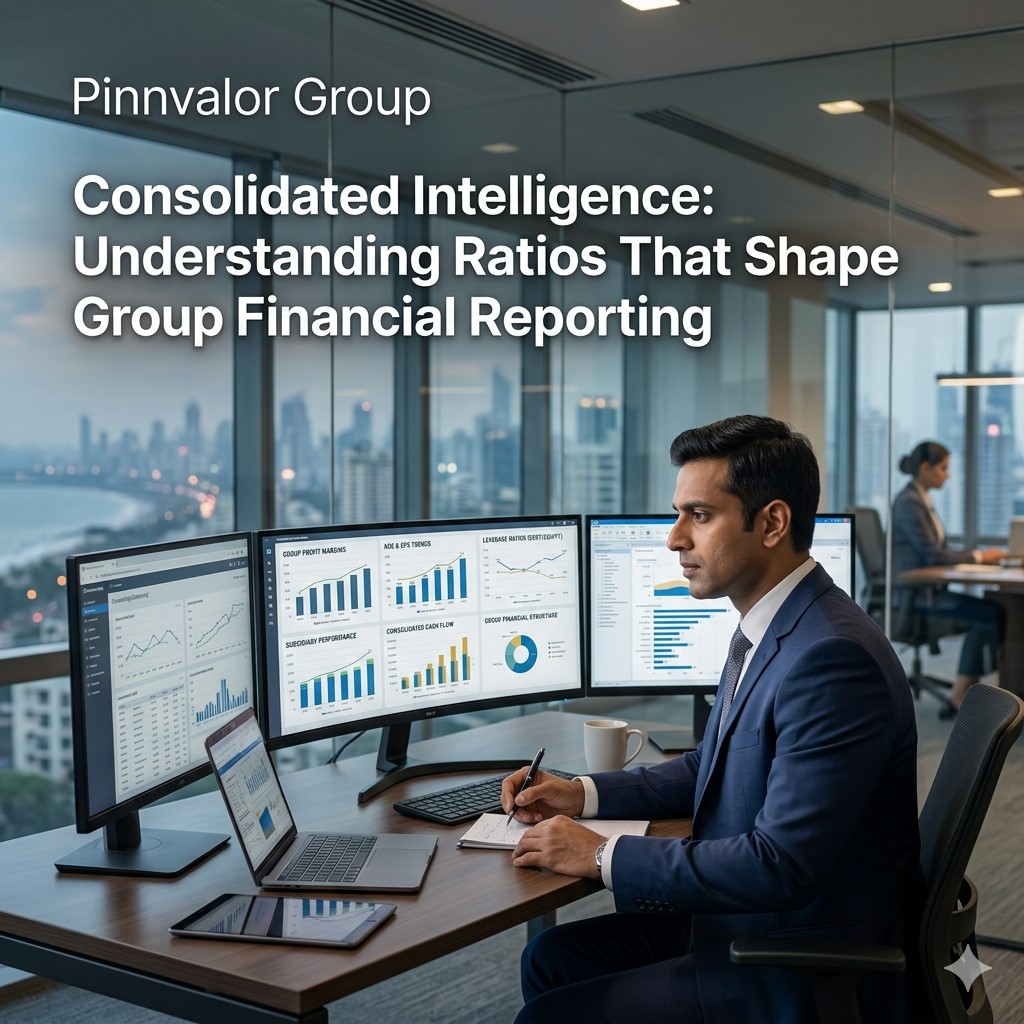
Consolidated Intelligence: Understanding Ratios That Shape Group Financial Reporting
In today’s interconnected business environment, financial performance is rarely evaluated at a standalone entity level. Instead, stakeholders—investors, regulators, and management—rely heavily on consolidated financial statements to understand the true economic health of a group.
What if your consolidated financials are telling only half the business story?
A group’s real strength is not in its combined revenue, but in how efficiently it converts resources into value. Consolidation ratios expose whether growth is truly sustainable or structurally inflated.
However, consolidated financial statements alone are not enough. The real insight lies in consolidation ratios and performance metrics that translate complex group structures into meaningful financial intelligence.
Why Consolidation Ratios Matter
Consolidation ratios bridge the gap between raw financial aggregation and strategic interpretation. They help stakeholders answer critical questions such as:
- How efficiently is the group generating returns across subsidiaries?
- Is debt risk concentrated in specific entities or spread across the group?
- Are minority interests significantly impacting overall profitability?
- What is the true operational performance after intercompany eliminations?
Without these ratios, consolidated reports risk becoming just a collection of adjusted numbers rather than actionable insights.
Key Consolidation Ratios and Metrics
1. Group Profitability Ratios
These ratios evaluate how effectively the entire group generates profits after consolidation adjustments.
- Consolidated Net Profit Margin = Consolidated Net Profit / Consolidated Revenue
- Group ROE (Return on Equity) = Net Profit Attributable to Parent / Parent Equity
- EBITDA Margin (Group Level) = EBITDA / Total Operating Revenue
These metrics highlight whether group expansion is actually translating into sustainable profitability.
2. Leverage and Capital Structure Ratios
Group structures often mask leverage distribution across subsidiaries. Consolidated ratios help uncover true financial risk.
- Debt-to-Equity (Consolidated) = Total Group Debt / Total Equity
- Net Debt Ratio = (Total Debt – Cash & Equivalents) / EBITDA
- Interest Coverage Ratio = EBIT / Interest Expense
These metrics are crucial for assessing whether the group’s expansion strategy is financially sustainable.
3. Efficiency and Asset Utilization Ratios
These ratios measure how effectively group assets are deployed across subsidiaries.
- Asset Turnover Ratio = Consolidated Revenue / Total Assets
- Return on Assets (ROA) = Net Income / Total Assets
A declining trend in these ratios may indicate inefficient capital allocation across group entities.
4. Minority Interest Impact Metrics
In consolidated reporting, minority (non-controlling) interests play a significant role in shaping final outcomes.
- Minority Interest Ratio = Non-Controlling Interest Profit / Total Group Profit
- Parent Profit Contribution = Net Profit Attributable to Owners / Total Consolidated Profit
These metrics help investors understand how much value is truly accruing to the parent company.
5. Intercompany Adjustment Indicators
Consolidation involves eliminating internal transactions, which can significantly distort standalone figures if not analyzed properly.
- Intercompany Revenue Ratio = Intercompany Sales / Total Revenue
- Elimination Impact Index = Adjustments due to consolidation / Reported Revenue
High dependency on intercompany transactions may signal revenue concentration risk within the group.
Strategic Insights from Consolidation Metrics
When analyzed together, these ratios transform consolidated financial statements into a strategic decision-making tool.
- Identify underperforming subsidiaries within the group structure
- Optimize capital allocation across business units
- Strengthen debt management at the group level
- Improve transparency for investors and regulators
Conclusion
Consolidated financial reporting is no longer just about compliance—it is about intelligence. Consolidation ratios and metrics provide the analytical depth needed to understand how group entities interact, perform, and contribute to overall value creation.
In a world where business groups are becoming increasingly complex, mastering these metrics is essential for accurate financial interpretation and strategic leadership.